Why CRM Data Quality Is Becoming a Competitive Advantage for Recruitment Firms
Recruitment has always been about relationships, speed and making the right connections at the right time. But as AI, automation and integrations become part of everyday recruitment, there’s another factor that’s becoming just as important which is the quality of your CRM data.
Whether you’re using Bullhorn, Invenias, Salesforce or another recruitment CRM, your data is the engine that powers your business. If it’s incomplete, duplicated or out of date, it doesn’t just create frustration for your team, it can prevent you from getting the most from the technology you’ve invested in.
For recruitment firms looking to work smarter, improve efficiency and embrace AI, clean CRM data is no longer just good housekeeping. It’s becoming a real competitive advantage.



Your CRM Should Be Working for You
Most recruiters know the feeling.
You search for a candidate and find three different records.
A client contact has changed jobs, but the information hasn’t been updated.
Candidate notes are stored in different places, making it difficult to build a complete picture.
These issues might seem small individually, but they quickly add up.
Poor data quality means recruiters spend more time searching for information, updating records manually and correcting mistakes instead of speaking to candidates and clients.
When every placement counts, those lost minutes soon become lost opportunities.
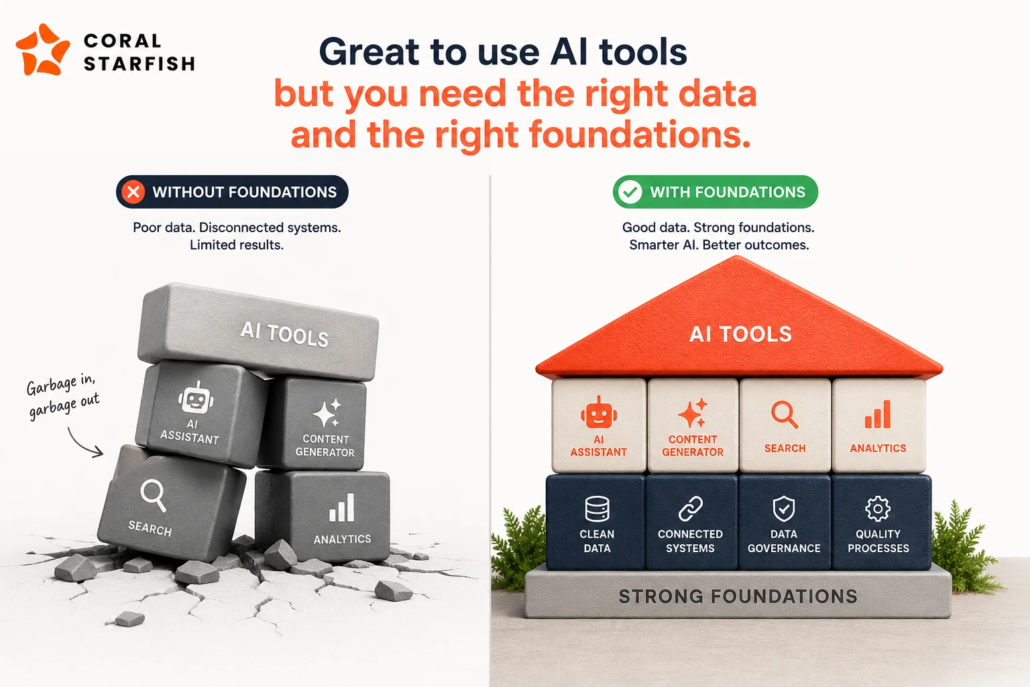
AI Is Only as Good as the Data Behind It
There’s a huge amount of excitement around AI in recruitment, and rightly so.
From candidate matching and CV summarisation to automated communications and workflow automation, AI has the potential to transform how recruitment businesses operate.
But there’s one important truth that often gets overlooked.
AI doesn’t fix poor data.
It amplifies it.
If your CRM contains duplicate candidates, incomplete records or outdated client information, AI will simply work with that same inaccurate data. The result is lower-quality recommendations, unreliable reporting and automation that creates more work instead of less.
Before implementing AI, recruitment firms should be asking one important question:
Can we trust the data we’re feeding into it?
The Hidden Cost of Poor CRM Data
Many recruitment businesses underestimate how much poor data costs them each year.
Some of the most common issues include:
- Duplicate candidate and client records
- Missing contact information
- Inconsistent formatting across records
- Outdated candidate status or availability
- Manual data entry errors
- Disconnected systems creating multiple versions of the same information
These problems don’t just affect recruiters.
They impact sales teams, management reporting, compliance, marketing activity and client service.
When everyone is working from different information, decision-making becomes slower and less reliable.
Better Data Creates Better Automation
Automation is one of the biggest opportunities for recruitment businesses looking to scale without increasing headcount.
Simple automations can:
- Update CRM records automatically
- Synchronise candidate information across systems
- Reduce manual data entry
- Trigger workflows when records are updated
- Improve reporting accuracy
- Keep consultants focused on recruiting rather than administration
However, automation only works effectively when the underlying data is accurate.
Think of it like building a house.
Automation is the roof.
AI is the furniture.
Your CRM data is the foundation.
Without strong foundations, everything built on top becomes unstable.
Making Bullhorn and Invenias Work Harder
Platforms like Bullhorn and Invenias are incredibly powerful recruitment CRMs.
Yet many firms only use a fraction of their capabilities because the quality of their data limits what’s possible.
With clean, well-managed data, recruitment businesses can:
- Improve candidate search results
- Deliver more accurate reporting
- Create seamless integrations with LinkedIn and other platforms
- Reduce duplication across systems
- Enable AI-powered workflows with greater confidence
- Give consultants more time to focus on placements rather than administration
Instead of becoming an administrative burden, your CRM becomes a genuine business asset.

Practical Steps to Improve CRM Data Quality
Improving data quality doesn’t need to involve a complete system overhaul.
Small improvements can make a significant difference over time.
Audit Your Existing Data
Start by identifying duplicate records, incomplete information and outdated contacts.
Understanding the current state of your CRM provides a clear roadmap for improvement.
Standardise Data Entry
Agree consistent rules for entering candidate and client information.
Simple standards help reduce inconsistencies across teams.
Remove Duplicate Records
Duplicate candidates create confusion, inaccurate reporting and wasted recruiter time.
Regular data cleansing helps maintain a single source of truth.
Connect Your Systems
Many data issues arise because information is entered multiple times across disconnected platforms.
Integrating systems reduces manual input and keeps information synchronised automatically.
Introduce Data Governance
Good data quality isn’t a one-off project.
Establish clear ownership, regular reviews and processes to keep your CRM accurate as your business grows.
Data Quality Is Becoming a Competitive Advantage
The recruitment firms seeing the biggest benefits from AI aren’t necessarily those investing the most.
They’re the ones investing in the right foundations first.
Clean data leads to better automation.
Better automation gives recruiters more time.
More time means stronger relationships, faster placements and better service for both candidates and clients.
As AI continues to evolve, the gap between businesses with trusted, well-managed data and those without will only grow wider.
How Coral Starfish Can Help
At Coral Starfish, we believe the best CRM is one recruiters don’t have to think about.
Instead of asking recruiters to stop what they’re doing and update records manually, we bring the CRM into the places they already work, such as LinkedIn, to help capture information as part of the recruitment process, not as an extra administrative task.
The result is richer, more consistent CRM data, fewer duplicate records and far less reliance on manual updates.
When recruiters don’t have to switch between systems or remember to update records later, data quality improves naturally. Your CRM becomes a trusted source of information rather than another system that’s difficult to keep up to date.
These stronger foundations don’t just make life easier today, they also prepare your business for tomorrow. High-quality, consistent data is what enables AI, automation and integrations to deliver real value.
Because before AI can transform recruitment, you need data you can trust.
If you’re looking to improve CRM adoption, increase data quality and build the right foundations for future AI and automation, we’d love to show you how Coral Starfish can help.